Wellbeing Space
-
March 10, 2026
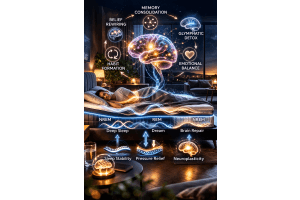
Every night, while the body appears still, the brain is intensely active. Neurons fire in rhythmic patterns. Synapses strengthen and weaken. Metabolic waste is cleared. Hormones fluctuate in carefully timed cycles. Memory fragments are reorganized into coherent narratives. Sleep is not passive rest. It is biological reconstruction.
-
March 03, 2026
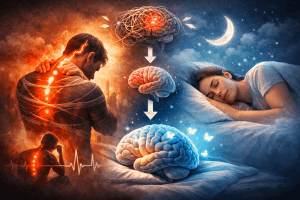
It is common in everyday life to hear people describe emotions as “bottled up,” “heavy,” “in my bones,” or “stuck in my body.” Far from being metaphors alone, these expressions reflect real psychological and physiological processes. Emotions are not just mental phenomena — they can influence body systems, muscular tension, nervous system activation, and even how we sleep. In this blog, we will explore:
- Somatisation of stress
- Fascial tension and nocturnal holding patterns
- How the sleep environment can act as a “mental detox”
- What emotional hypersensitivity looks like after poor sleep
-
February 20, 2026
We live in an age of constant stimulation. Decisions, deadlines, conversations, screens, noise, responsibilities — all compete for attention. During the day, our body adapts. It compensates. It pushes forward.
But there is only one moment in every 24 hours when the body is not performing for the world. Only one phase when the nervous system stops defending, the emotions stop reacting, memory stops collecting, and hormones stop chasing stress.
-
February 13, 2026
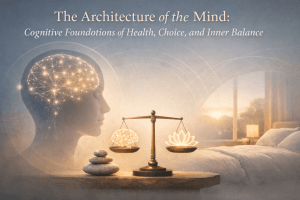
Human health is often described through visible actions - what we eat, how we move, how much we sleep, or how often we seek medical care. Yet beneath all these behaviors lies a less visible but more powerful force: the architecture of the mind. How we perceive reality, where we direct attention, how we interpret experience, and how we choose to act form the cognitive foundation upon which health and well-being are built. In modern life, the human mind operates under constant pressure. Continuous stimulation, digital saturation, fragmented attention, and accelerated decision-making disrupt the brain’s natural rhythms. Over time, this does not simply result in tiredness; it erodes cognitive clarity, emotional regulation, and inner balance.
-
February 06, 2026
Every moment of the day, your body is following a hidden rhythm - a biological clock that orchestrates many of your internal processes: sleep, hormone release, metabolism, cell repair, immune activity, and more. This circadian rhythm keeps you in tune with day and night, guiding when you feel alert, when you feel tired, and even how your immune system responds to threats. In this article, we explore what circadian rhythm and immunity are, how they function, why maintaining them is crucial, what happens when they are disrupted, and how sleep strengthens your body’s defenses. We will also gently tie in how a good mattress (like the NadaUp mattress) supports these processes.
-
January 30, 2026
Imagine a person - let’s call them the Reader - who notices that despite eating sensibly, their energy feels unstable, mood dips in the afternoon, and their weight creeps upward. Unknown to them, poor sleep could be quietly disrupting the delicate interplay between blood sugar and insulin. This blog explores how lifestyle factors - like what you eat first, bedtime rituals, and mattress quality - affect insulin resistance and blood sugar, and how optimized sleep (especially on an empty stomach) can help.
-
January 23, 2026
Food is not only fuel for the body; it is information for every cell. The nutrients we consume influence our hormones, brain chemistry, and even the rhythms of sleep. In recent years, however, a new type of food has entered the global conversation - bio-engineered foods, including cultured meat and 3D-printed meals. These are presented as sustainable, nutrient-rich, and futuristic alternatives to natural foods. But do they truly support health and quality sleep, or are they cleverly marketed illusions?
-
January 13, 2026
Health and happiness are never achieved by a single factor. They are built on a foundation of small, everyday choices and natural allies that support our physical, emotional, and spiritual balance. If you observe closely, six “best friends” walk with us every step of life: sunlight, exercise, diet, self-confidence, friends, and quality sleep. These companions are not luxuries; they are necessities for survival, growth, and fulfillment. Just like a tree needs water, soil, and sunlight to flourish, humans need these six foundations to thrive. Let’s explore each one, understand its benefits, and learn how to cultivate them in daily life.
-
January 09, 2026
In 1935, Albert Einstein, Boris Podolsky, and Nathan Rosen introduced a paradox that shook physics. Known as the EPR paradox, it described a peculiar phenomenon later called quantum entanglement. Two photons, when created together, seemed to share a fate: a change in one instantly mirrored the other, regardless of distance. Einstein dismissed it as “spooky action at a distance”, yet modern experiments have consistently shown this is real. In 1982, physicist Alain Aspect in Paris conducted the first landmark test confirming entanglement, using pairs of polarized photons (Aspect, Dalibard, & Roger, 1982). Today, entanglement is not just theory - it is the foundation of quantum communication, quantum computing, and even discussions about consciousness. But beyond physics, what does this mean for human beings - for consciousness, energy, and balance?
-
January 02, 2026
Every night, while your body lies still, your brain is far from inactive. It runs an invisible night shift that rewires, repairs, and reshapes itself. This extraordinary ability is called neuroplasticity - the brain’s capacity to change its structure and function throughout life. Unlike a machine with fixed parts, the human brain is dynamic, adapting continuously to experiences, learning, and challenges. For centuries, it was believed that the adult brain was rigid, set in its pathways after childhood. But groundbreaking neuroscience research has shown the opposite: the brain is capable of lifelong adaptation. And one of the most critical factors fueling this change is not more effort or endless study, but something far simpler - sleep.