The Architecture of the Mind: Cognitive Foundations of Health, Choice, and Inner Balance
Human health is often described through visible actions - what we eat, how we move, how much we sleep, or how often we seek medical care. Yet beneath all these behaviors lies a less visible but more powerful force: the architecture of the mind. How we perceive reality, where we direct attention, how we interpret experience, and how we choose to act form the cognitive foundation upon which health and well-being are built. In modern life, the human mind operates under constant pressure. Continuous stimulation, digital saturation, fragmented attention, and accelerated decision-making disrupt the brain’s natural rhythms. Over time, this does not simply result in tiredness; it erodes cognitive clarity, emotional regulation, and inner balance.
The consequences are subtle at first - difficulty concentrating, rigid thinking, emotional reactivity - but they accumulate into long-term mental and physical strain. This article explores the core cognitive capacities that allow individuals to remain adaptable, focused, and intentional in a complex world. These capacities are not abstract psychological ideals; they are biologically grounded processes, deeply influenced by nervous system regulation, daily habits, and - critically - the quality of sleep and recovery that the brain receives.
Cognitive Flexibility: The Ability to Shift Perspective
Cognitive flexibility refers to the brain’s capacity to adapt thinking and behavior when circumstances change. It allows individuals to revise assumptions, update beliefs, and move beyond rigid interpretations of events. In healthy cognition, flexibility supports learning,ive a generalized example illustrates its importance.
Consider an individual encountering repeated obstacles in daily responsibilities. Without cognitive flexibility, each obstacle is interpreted as personal failure, reinforcing stress and self-criticism. With flexibility, the same experiences are seen as temporary challenges or feedback, allowing adjustment rather than emotional stagnation.
Neuroscientific research links cognitive flexibility to executive functions centered in the prefrontal cortex. When this system is compromised by chronic stress, poor sleep, or overstimulation, thinking becomes rigid and reactive. Over time, inflexible thinking patterns are associated with anxiety, depressive symptoms, and impaired decision-making.
Cognitive flexibility does not eliminate difficulty. Instead, it preserves mental mobility in the presence of difficulty, making it a cornerstone of adaptive health and psychological resilience.
Attention and Concentration: Managing Mental Resources
Attention is a finite biological resource. What we attend to determines what the brain processes, strengthens, and ultimately integrates into behavior. Concentration is the sustained direction of attention toward a chosen task or internal state.
In everyday life, many individuals attempt to divide attention across multiple tasks - working, communicating, consuming information - simultaneously. Although this may feel efficient, research consistently demonstrates that multitasking degrades cognitive performance, increases error rates, and elevates mental fatigue. The brain is forced into constant switching, preventing deep focus and meaningful recovery.
Effective attention regulation supports learning, emotional stability, and memory consolidation. Fragmented attention, by contrast, increases cognitive noise and physiological stress responses. Over time, poor attention management weakens reflective capacity and contributes to chronic mental exhaustion.
Training attention toward fewer, more meaningful inputs allows the nervous system to stabilize. This stabilization is not merely psychological; it is a biological prerequisite for cognitive clarity and emotional balance.
Choice of Thoughts and Beliefs: Constructing Personal Narratives
Human beings do not respond directly to events; they respond to interpretations of events. Thoughts and beliefs form internal narratives that give experiences meaning. These narratives shape emotional reactions, behavioral choices, and even physiological responses.
A generalized scenario illustrates this clearly. Two individuals encounter the same uncertainty. One interprets it as threat, triggering anxiety and avoidance. The other interprets it as a transitional phase, responding with curiosity and planning. The external reality is identical; the internal narrative determines the outcome.
Cognitive science shows that repeated thought patterns strengthen specific neural pathways. Over time, beliefs become automatic filters through which experiences are processed. Persistent negative belief patterns are associated with heightened stress responses, while adaptive narratives support emotional regulation and resilience.
Developing awareness of thought patterns allows individuals to consciously shape narratives aligned with reality, values, and long-term well-being. This is not forced optimism, but deliberate cognitive engagement.
Hemispheric Synchronization: Balancing Logic and Intuition
The brain exhibits functional specialization, often simplified as analytical and intuitive modes of processing. While this division is not absolute, healthy cognition depends on cooperation between these modes rather than dominance of one.
Hemispheric synchronization refers to the integration of logical reasoning with emotional and intuitive awareness. When this balance is disrupted, individuals may become excessively analytical, disconnected from bodily signals and emotional insight, or overly intuitive without critical evaluation.
A generalized decision-making example highlights this dynamic. Excessive analysis can lead to paralysis, while neglecting analytical input can result in impulsive choices. Integrated cognition enables decisions that are both rational and aligned with internal values.
Neuroscientific research suggests that well-regulated cognition relies on coordinated activity across neural networks rather than isolated processing. Conditions that reduce mental noise and support nervous system regulation promote this integration, reinforcing cognitive coherence and emotional stability.
Thought Habits: Patterns That Support or Undermine Health
Thought habits are recurring mental patterns that operate largely outside conscious awareness. They develop through repetition and emotional reinforcement, gradually shaping perception, mood, and behavior.
A generalized individual may habitually anticipate negative outcomes, engage in excessive self-evaluation, or remain in a state of constant vigilance. While such patterns may have once served protective purposes, they often become maladaptive in stable environments, contributing to chronic stress and mental fatigue.
Research links persistent negative thought patterns to dysregulation of stress hormones and impaired immune functioning. Conversely, adaptive thought habits are associated with improved emotional regulation and cognitive performance.
Maintaining mental health requires cognitive hygiene - the regular examination and recalibration of habitual thought patterns - just as physical health requires ongoing care.
Intentionality: Acting in Alignment With Values
Intentionality is the capacity to align actions with consciously chosen values rather than reactive impulses. It bridges cognition and behavior, transforming insight into lived experience.
Under stress or fatigue, decisions are often driven by habit or external pressure. When intentionality is supported, actions reflect long-term priorities such as health, learning, and meaningful connection.
Neuroscientific research associates intentional action with executive control networks and emotional regulation systems. When these systems are adequately supported, individuals experience greater coherence between thought, emotion, and behavior.
Intentionality is not about perfection. It is about consistency and direction - small, repeated actions that gradually shape mental and physical well-being.
Cognitive Disruptors in Modern Life
Several factors systematically undermine cognitive balance:
-
Overstimulation: Constant sensory input exhausts attentional systems and prevents mental recovery.
-
Multitasking: Fragmented focus increases cognitive load and reduces efficiency.
-
Excessive analysis: Over-engagement of analytical processes suppresses intuition and emotional insight.
-
Lack of reflection: Without reflection, experiences are not integrated into learning.
-
Negative belief patterns: Persistent maladaptive narratives reinforce stress responses.
These disruptors interact, creating a cognitive environment characterized by noise, reactivity, and reduced self-regulation. Addressing them requires not withdrawal from modern life, but conscious structuring of attention, reflection, and recovery.
Sleep as the Biological Foundation of Cognitive Balance
Cognitive clarity does not arise from effort alone. It depends on biological conditions that allow the brain to recover, reorganize, and integrate information. High-quality sleep plays a central role in this process.
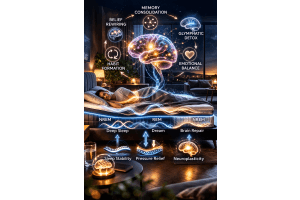
During deep and REM sleep stages, the brain consolidates learning, clears metabolic waste, and recalibrates emotional and attentional networks. Research shows that sleep supports executive functions such as cognitive flexibility, attention regulation, emotional balance, and decision-making. When sleep is insufficient or fragmented, these same functions deteriorate, leading to rigid thinking, reduced concentration, heightened emotional reactivity, and weakened intentional control.
A generalized example illustrates this relationship. An individual experiencing poor sleep may notice increased mental noise, difficulty shifting perspective, and a tendency toward negative interpretation. With consistent, restorative sleep, the same individual often reports clearer thinking, emotional steadiness, and improved alignment between intentions and actions.
Supportive sleep conditions further influence hemispheric integration. Well-rested brains demonstrate improved coordination between analytical reasoning and intuitive insight, allowing decisions that are both rational and internally coherent. The physical environment in which sleep occurs therefore plays a subtle but significant role.
Proper body support, temperature regulation, and pressure distribution allow the nervous system to enter deeper restorative states. Over time, this supports not only physical recovery but the cognitive foundations required for focus, flexibility, and intentional living.
Conclusion: Cognition, Sleep, and Inner Balance
Cognitive flexibility, attention regulation, belief formation, hemispheric balance, thought habits, and intentionality form an interconnected system shaping how individuals experience life. These capacities are inseparable from the body’s ability to rest and recover.
When sleep quality improves, cognition becomes clearer, emotions stabilize, and behavior aligns more naturally with values. In a world defined by stimulation and fragmentation, restoring cognitive balance begins not with doing more, but with recovering better. Sustainable well-being emerges where clear thinking, restorative sleep, and intentional living converge.
References
-
Kahneman, D. (2011). Thinking, Fast and Slow. Farrar, Straus and Giroux.
-
Damasio, A. (1994). Descartes’ Error: Emotion, Reason, and the Human Brain. Putnam.
-
Siegel, D. J. (2012). The Developing Mind: How Relationships and the Brain Interact to Shape Who We Are. Guilford Press.
-
Goleman, D. (2013). Focus: The Hidden Driver of Excellence. HarperCollins.
-
Baars, B. J., & Franklin, S. (2003). How conscious experience and working memory interact. Trends in Cognitive Sciences, 7(4), 166–172.
-
Miyake, A., et al. (2000). The unity and diversity of executive functions. Cognitive Psychology, 41(1), 49–100.
-
Davidson, R. J., & McEwen, B. S. (2012). Social influences on neuroplasticity. Nature Neuroscience, 15(5), 689–695.
-
Walker, M. (2017). Why We Sleep: Unlocking the Power of Sleep and Dreams. Scribner.
-
Diekelmann, S., & Born, J. (2010). The memory function of sleep. Nature Reviews Neuroscience, 11(2), 114–126.
-
Killgore, W. D. S. (2010). Effects of sleep deprivation on cognition. Progress in Brain Research, 185, 105–129.