Sleep as a Family Ritual: Building Harmony Across Generations
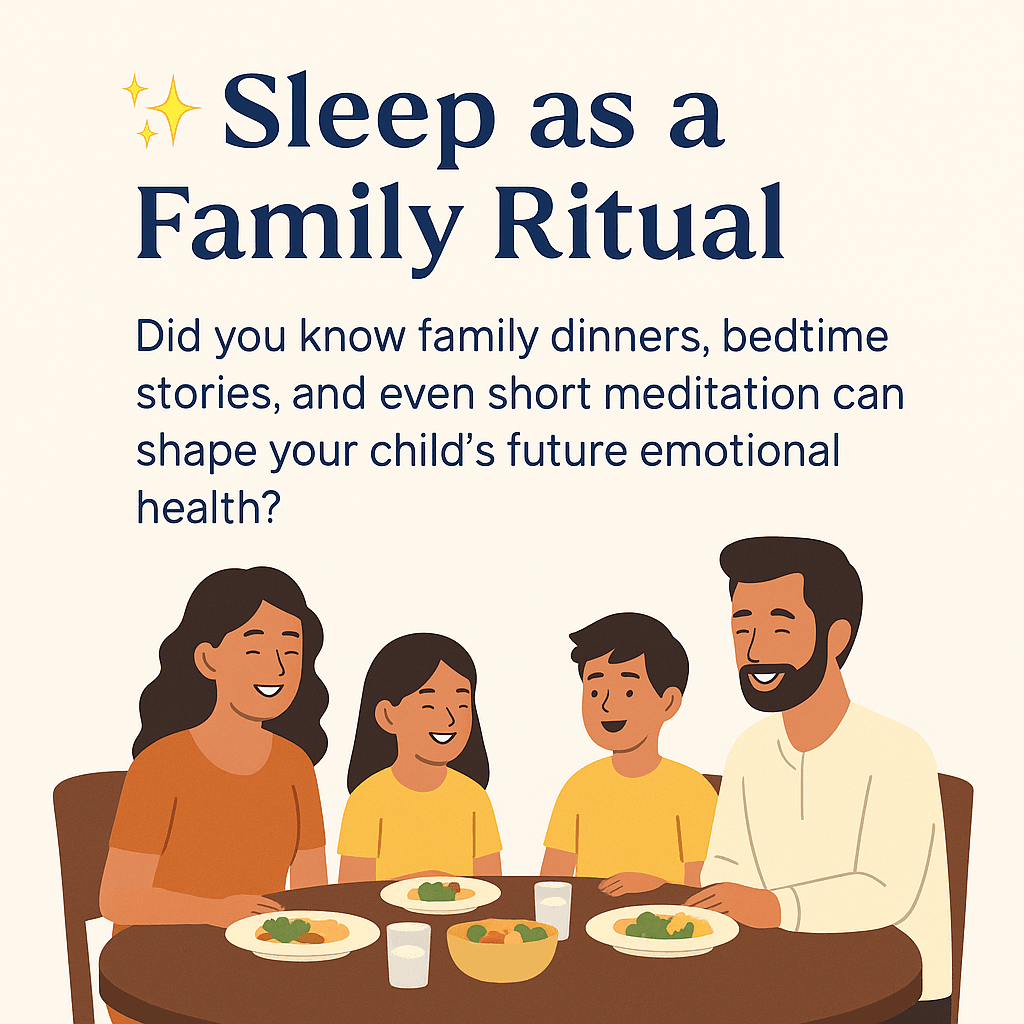
Every night, when the world quiets down, families have a choice. Some sit together for dinner, talk, share stories, pray, meditate, or read to their children. Others eat separately, scroll their phones, or slip into bed without connection. The difference is profound: one path fosters harmony across generations, while the other often leads to silent isolation. Sleep is not only an individual biological necessity; it is also a family ritual that connects hearts, heals conflicts, and strengthens emotional bonds. Across cultures - whether in Hindu households practicing sanskars, or Christian families giving thanks before meals - sleep preparation has always been more than closing the eyes. It is about creating a safe, loving environment where generations coexist and grow together.
Family Structures and Their Impact on Sleep & Harmony
Human societies have long been organized around three main family types. Each structure influences not only daily life but also how people approach bedtime, rest, and emotional support.
Joint (Multigenerational) Families
In villages, it is common to see grandparents, parents, and children sharing the same house. A child might fall asleep to the gentle stories of a grandmother, while the parents finish household tasks. The presence of elders creates security and a sense of heritage.
-
Advantages: Emotional richness, guidance from elders, shared burdens, financial support, and strong values. A child raised in such a home rarely feels “alone.”
-
Disadvantages: Privacy is scarce. Disagreements may arise over parenting methods or generational expectations. For example, a parent may want their child to learn coding, while the grandparent insists on more traditional learning.
Research suggests that intergenerational living offers significant educational and emotional support for children, though it can also bring challenges in decision-making [1].
Nuclear Families
This is the dominant model in modern cities - parents and children living apart from extended relatives. Dinner tables are smaller, and bedtime often revolves around digital devices rather than shared stories.
-
Advantages: Independence in parenting, modern values, privacy, flexibility.
-
Disadvantages: The absence of grandparents or extended family may limit children’s exposure to deeper wisdom and emotional cushioning. Parents, too, may feel the weight of raising children without support.
Individualistic Living
In its extreme, individualism separates family members not only by house but also emotionally. Each person eats when they want, sleeps when they want, and lives by their own rhythm.
-
Advantages: Total freedom, customized lifestyle, no compromise.
-
Disadvantages: Weakening of bonds, increased loneliness, fragmented emotional support. Children, in such contexts, may struggle with empathy and EQ development.
The Emotional Quotient and the Role of Grandparents
What is EQ?
Emotional Quotient (EQ) is the ability to recognize, understand, and regulate one’s emotions, and to empathize with others. Unlike IQ, which measures logic, EQ measures the heart’s intelligence. High EQ children grow into adults who can manage stress, show kindness, resolve conflicts, and build strong relationships.
Grandparents as EQ Builders
Grandparents act as bridges between past and present. Their slower pace of life contrasts with the busyness of parents, making them ideal emotional anchors. A University of Oxford study found that children with active grandparental involvement showed fewer behavioral problems and enjoyed stronger emotional health [2].
Consider a child who had a rough day at school. While the parent is caught in work stress, the grandparent listens patiently, shares a personal childhood story, and assures the child, “This too shall pass.” That reassurance, small as it seems, trains the child’s brain in emotional regulation.
Other studies reveal that emotional closeness with grandparents - not necessarily living together - is what predicts better outcomes [3]. Grandparents’ affection reduces loneliness and stress and creates resilience in children [4].
In societies that move rapidly toward nuclear and individual living, this wisdom is often lost. Children without regular contact with elders may develop strong technical skills but struggle with empathy, patience, and resilience.
The Dinner Table as a Sacred Ritual
For centuries, the dinner table has been more than a place to eat - it has been the altar of family unity.
The Science of Eating Together
Research shows that family meals improve grades, boost self-esteem, and reduce risks of depression, substance abuse, and even obesity [5]. A Canadian study followed children from age six to ten and found that those who had regular family dinners were healthier, fitter, and more socially skilled [6]. Harvard studies confirm that these benefits carry well into adulthood [7].
A Christian Ritual
In many Christian households, family members hold hands before meals, bow their heads, and thank God for the food. This practice instills gratitude, humility, and unity. For children, it creates a memory: meals are not just about filling the stomach but about honoring life and togetherness.
Hindu Sanskars
In Hindu traditions, gathering for meals, sharing stories, and blessing the food are part of sanskars - cultural imprints that shape the moral fabric of children. Elders may tell tales from the Mahabharata or Ramayana, embedding timeless lessons about duty, kindness, and courage.
The dinner table, therefore, becomes a classroom - not of equations or history, but of values and empathy.
Storytelling and Meditation: The Final Evening Touch
Storytelling Before Sleep
Imagine a grandmother narrating a folk tale about a farmer who worked hard but never gave up. The child, listening with wide eyes, not only absorbs language and imagination but also the embedded value of perseverance. Research shows that storytelling nurtures curiosity, emotional security, and mental well-being.
Meditation Together
After storytelling, if the family sits together for even five minutes of meditation, the physiological effects are profound. Studies show that mindfulness reduces cortisol (the stress hormone) and increases serotonin and melatonin, enhancing both happiness and sleep [8][9]. Meditation also improves HRV, which is an indicator of resilience to stress.
A simple practice - sitting quietly, focusing on the breath, perhaps holding hands - becomes a ritual that lowers family tension and prepares everyone for deep rest.
NadaUp Mattress: The Final Step to Harmony
After these rituals - dinner, gratitude, stories, meditation - the family retires for the night. This is where the NadaUp mattress becomes more than furniture; it becomes the silent guardian of harmony.
-
Its orthopedic medical design supports the spine, reducing pain and aligning posture.
-
Advanced pressure relief ensures no tossing and turning disturbs the calm built through meditation.
-
Breathable materials keep the body cool, preventing restlessness.
-
Motion isolation ensures that if one family member moves, others continue to sleep undisturbed.
Tested and approved by MHRA, NICE, CSP, and ACPOHE, NadaUp mattresses combine hospital-quality assurance with home comfort [10]. After a day of bonding, storytelling, and meditation, a good night’s sleep on NadaUp ensures that harmony continues into the next day.
A Story to Remember
Imagine the Verma family in a small town. Every evening, they sit together for dinner. Before eating, they join hands, close their eyes, and thank God. The children share their day - the little victories, the disappointments. The parents listen; the grandparents advise softly. After dinner, the grandfather tells a folk tale about bravery, while the children listen, giggling yet thoughtful. Finally, the family sits together in silence, practicing a few minutes of meditation.
That night, when they sleep on their NadaUp mattresses, the calmness of these rituals follows them. They drift quickly into deep sleep, their cortisol levels low, their minds at peace, their hearts connected. They wake the next day, refreshed and bonded.
This is not just sleep - it is harmony across generations.
References
-
Steadman, M., Everett, B. G., & Geist, C. (2024). Coresidence with grandparents and children’s socioemotional health in kindergarten. Population Research and Policy Review, 43(37).
-
Buchanan, A. (2012). Grandparents contribute to children’s well-being. University of Oxford Report.
-
Rapoport, E., Muthiah, N., Keim, S. A., & Adesman, A. (2020). Family well-being in grandparent- versus parent-headed households. Pediatrics, 146(3), e20200115.
-
Bernhold, Q. S. (2019). Grandparents' affectionate communication toward grandchildren and grandchildren's mental health difficulties. Health Communication.
-
The Family Dinner Project. (n.d.). Benefits of family dinners. The Family Dinner Project.
-
Pagani, L., & Harbec, M.-J. (2017). Eating together as a family helps children feel better, physically and mentally. Journal of Developmental & Behavioral Pediatrics.
-
Harvard Medical School. (2014). Lifelong impact of family dinners. A Better Meal.
-
Black, D. S., O’Reilly, G. A., Olmstead, R., Breen, E. C., & Irwin, M. R. (2015). Mindfulness meditation and improvement in sleep quality and daytime impairment among older adults with sleep disturbances. JAMA Internal Medicine, 175(4), 494–501.
-
Rusch, H. L., Rosario, M., Levison, L. M., Olivera, A., Livingston, W. S., Wu, T., & Gill, J. M. (2019). The effect of mindfulness meditation on sleep quality: A systematic review and meta-analysis. Annals of the New York Academy of Sciences, 1445(1), 5–16.
-
NadaUp Internal Testing. (2024). Mattress sleep tests and certifications [Product Report].