The Thoughts You Choose Before Sleep Create the Next Day — The Scientific Explanation

There is a quiet moment every night that most people underestimate.
You turn off the light. The room becomes still. Your breathing slows. Your body sinks into the mattress. And for a few seconds, your mind speaks its final sentences before surrendering to sleep.
Those final thoughts are not random.
They are instructions.
Modern neuroscience increasingly suggests that the cognitive and emotional states we carry into sleep influence how the brain filters information, consolidates memory, regulates emotion, and even determines what we perceive the next day. What once sounded philosophical now has measurable biological pathways behind it.
In this article, we will explore the scientific mechanisms behind this phenomenon:
-
The Reticular Activating System and perceptual filtering
-
Theta brain waves before sleep
-
Intention as a perceptual calibration tool
-
How physical sleep stability supports neurological transformation
This is not about positive thinking slogans. It is about neural gating systems, memory consolidation, attentional networks, and sleep architecture.
And once you understand the biology, your bedtime becomes one of the most powerful cognitive tools you possess.
1. The Reticular Activating System: The Brain’s Filter of Reality
The human brain processes an overwhelming amount of sensory input every second. Visual signals, sounds, body sensations, internal thoughts — the total data load is impossible to consciously handle.
The Reticular Activating System (RAS), located in the brainstem, functions as a gatekeeper. It regulates arousal, wakefulness, and — critically — attention selection. It determines what enters conscious awareness and what gets filtered out [1].
If you decide to buy a red car, suddenly red cars appear everywhere. They were always there. Your RAS simply recalibrated what it considers relevant.
This filtering system is influenced by beliefs, emotional salience, and pre-sleep cognition.
Research in attentional neuroscience demonstrates that top-down cognitive frameworks influence sensory gating and perceptual bias [2]. In simple terms: what you expect, you notice.
Now consider the moment before sleep.
When you repeatedly focus on stress, resentment, or fear before sleeping, you are priming your attentional networks. You are tagging certain emotional themes as “important.”
The RAS listens.
During sleep, especially across REM cycles, emotional memories are processed and integrated [3]. The themes you emphasized before sleep are more likely to be consolidated and prioritized.
The next morning, your perceptual system wakes up already tuned to detect evidence consistent with last night’s mental emphasis.
This is not mystical. It is attentional calibration.
2. Theta Waves: The Gateway State of Suggestibility
As you transition from wakefulness into sleep, your brain shifts from beta waves (active thinking) into alpha and then theta waves (4–8 Hz).
Theta activity is strongly associated with hypnagogia - the transitional state between wake and sleep. This state is characterized by heightened imagery, memory access, and increased neural plasticity [4].
Research suggests that theta states are linked to:
-
Memory encoding
-
Emotional processing
-
Enhanced suggestibility
-
Hippocampal–cortical communication [5]
In other words, the brain becomes more impressionable.
A generalized example:
Imagine someone lying in bed replaying a conflict from the day. They rehearse what they should have said. They imagine future confrontations. The emotional charge remains active.
During the theta transition, this emotionally salient content becomes neurologically prioritized. The amygdala (emotional salience detector) remains engaged, and the hippocampus integrates the narrative into memory networks.
Now imagine the same person instead deliberately shifting attention to problem-solving, gratitude, or constructive planning.
The same neuroplastic window is active - but the content changes.
The theta gateway does not judge. It encodes.
Books such as Why We Sleep by Matthew Walker describe how memory consolidation and emotional recalibration occur across sleep cycles [6]. Research also shows that slow oscillations and sleep spindles coordinate hippocampal–cortical dialogue during consolidation [7].
The state before sleep influences the material available for consolidation.
This is why pre-sleep cognitive framing matters.
3. Intention as a Perceptual Calibration Tool
Intention is often misunderstood as mere motivation. Neuroscience frames it differently.
Intention activates prefrontal networks responsible for goal-directed attention and executive function [8]. When an intention is formed, it alters attentional bias and increases the probability of noticing goal-relevant stimuli.
In cognitive science, this relates to predictive coding - the theory that the brain constantly generates models about the world and updates them based on sensory input [9].
Your intention modifies the prediction model.
When someone goes to sleep thinking, “Tomorrow I will look for opportunities,” the brain is not performing magic overnight. It is adjusting predictive weighting.
The next day, ambiguous stimuli are more likely interpreted as opportunity rather than threat.
Research in sleep and problem solving suggests that incubation during sleep enhances insight and creative restructuring [10]. REM sleep, in particular, appears to promote associative thinking and novel connections [11].
Thus, intention before sleep may influence:
-
Memory prioritization
-
Emotional tone recalibration
-
Insight probability
-
Perceptual bias upon waking
A person who ends the day with structured reflection - identifying lessons rather than failures - feeds the neural system with different emotional markers.
The brain integrates accordingly.
4. Emotional Charge, Sleep Architecture, and Stability
For intention and perceptual calibration to work effectively, sleep architecture must remain intact.
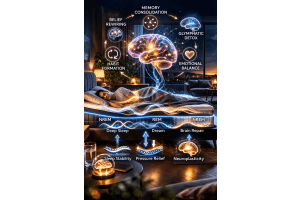
Sleep occurs in structured cycles:
-
NREM Stage 1 (transition)
-
NREM Stage 2 (sleep spindles, memory consolidation)
-
NREM Stage 3 (deep slow-wave sleep, physical restoration)
-
REM (emotional integration, associative processing)
Fragmented sleep disrupts these cycles.
Research shows that sleep deprivation amplifies amygdala reactivity and reduces prefrontal regulation [12]. In simple terms, poor sleep increases emotional overreaction.
If sleep is unstable due to discomfort, overheating, or pressure points, micro-arousals occur. These interruptions fragment memory consolidation and emotional recalibration processes [13].
Pressure relief and thermoregulation are not luxury features. They directly influence arousal frequency and sleep continuity.
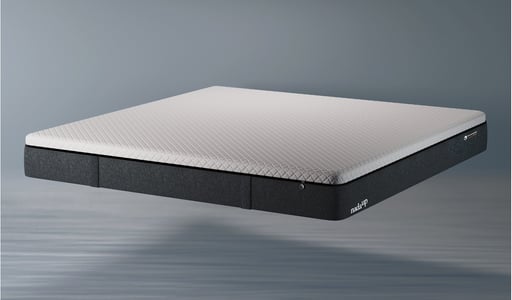
NadaUp mattresses utilize Mammoth Medical Grade™ foam technology designed to redistribute pressure and reduce physical tension, supporting uninterrupted sleep cycles
EN NadaUp - Every night Matters…
Clinical testing has demonstrated:
-
60% pressure relief
-
29% faster time to fall asleep
-
7% improvement in sleep efficiency
-
69% faster surface cooling
EN NadaUp - Every night Matters…
Reduced pressure lowers nociceptive input (pain signaling). Lower pain reduces micro-awakenings. Fewer awakenings preserve NREM–REM cycling.
When sleep cycles remain intact:
-
Emotional memories are reprocessed
-
The amygdala is recalibrated
-
Prefrontal regulation strengthens
-
Memory consolidation improves
The neuro-state required for transformation depends on physiological stability.
A destabilized body destabilizes sleep architecture.
Stable support enables neuroplastic work to proceed without interruption.
5. A Generalized Example of Nightly Recalibration
Consider a professional who experiences a difficult meeting during the day.
Two possible pre-sleep scenarios unfold.
Scenario A:
They replay the conflict, feel anger, predict future confrontation, and fall asleep with physiological stress activation.
During REM, the emotional charge remains strong. The next morning, their attentional system scans for threat. Neutral expressions appear hostile. Minor inconveniences feel significant.
Scenario B:
They reflect constructively. They identify lessons. They mentally rehearse calm responses. They consciously choose a forward-oriented perspective.
During sleep, the same neural systems integrate this framing. Emotional intensity decreases. The predictive model shifts.
The next morning, their perception is measurably different.
The external world did not change.
The internal filter did.
6. Books and Research Supporting This Framework
Several influential works discuss components of this phenomenon:
-
Why We Sleep by Matthew Walker - sleep architecture, memory consolidation, emotional recalibration [6]
-
The Brain That Changes Itself by Norman Doidge - neuroplasticity principles [14]
-
The Expectation Effect by David Robson - cognitive bias and perception shaping [15]
-
Thinking, Fast and Slow by Daniel Kahneman - attentional bias and cognitive filtering [16]
-
Research on REM and emotional regulation by Matthew Walker and colleagues [3]
-
Predictive coding models described by Karl Friston [9]
While these works approach the topic from different angles, they converge on one principle:
The brain is plastic.
Sleep is integrative.
Attention shapes perception.
And the pre-sleep state influences the system entering that integrative phase.
Conclusion: Every Night Is a Neural Vote for Tomorrow
The final thoughts before sleep are not casual.
They are inputs into:
-
Attentional gating systems
-
Emotional memory consolidation
-
Predictive modeling networks
-
Neural plasticity mechanisms
The Reticular Activating System calibrates relevance.
Theta states increase impressionability.
Intention modifies predictive frameworks.
Stable sleep architecture enables integration.
When the body is supported - through pressure redistribution, thermoregulation, and reduced micro-arousals - the brain can complete its nightly recalibration without interruption
EN NadaUp - Every night Matters…
The question is not whether your thoughts before sleep influence tomorrow.
The question is:
What are you instructing your nervous system to prioritize tonight?
Because every night matters.
References
-
Moruzzi, G., & Magoun, H. W. (1949). Brain stem reticular formation and activation of the EEG. Electroencephalography and Clinical Neurophysiology, 1(4), 455–473.
-
Desimone, R., & Duncan, J. (1995). Neural mechanisms of selective visual attention. Annual Review of Neuroscience, 18, 193–222.
-
Walker, M. P., & van der Helm, E. (2009). Overnight therapy? The role of sleep in emotional brain processing. Psychological Bulletin, 135(5), 731–748.
-
Cavanagh, J. F., & Frank, M. J. (2014). Frontal theta as a mechanism for cognitive control. Trends in Cognitive Sciences, 18(8), 414–421.
-
Buzsáki, G. (2006). Rhythms of the Brain. Oxford University Press.
-
Walker, M. (2017). Why We Sleep: Unlocking the Power of Sleep and Dreams. Scribner.
-
Rasch, B., & Born, J. (2013). About sleep’s role in memory. Physiological Reviews, 93(2), 681–766.
-
Miller, E. K., & Cohen, J. D. (2001). An integrative theory of prefrontal cortex function. Annual Review of Neuroscience, 24, 167–202.
-
Friston, K. (2010). The free-energy principle: A unified brain theory? Nature Reviews Neuroscience, 11(2), 127–138.
-
Wagner, U., Gais, S., Haider, H., Verleger, R., & Born, J. (2004). Sleep inspires insight. Nature, 427(6972), 352–355.
-
Cai, D. J., Mednick, S. A., Harrison, E. M., Kanady, J. C., & Mednick, S. C. (2009). REM, not incubation, improves creativity. Proceedings of the National Academy of Sciences, 106(25), 10130–10134.
-
Yoo, S. S., Gujar, N., Hu, P., Jolesz, F., & Walker, M. P. (2007). The human emotional brain without sleep. Current Biology, 17(20), R877–R878.
-
Bonnet, M. H., & Arand, D. L. (2003). Clinical effects of sleep fragmentation. Sleep Medicine Reviews, 7(4), 297–310.
-
Doidge, N. (2007). The Brain That Changes Itself. Viking.
-
Robson, D. (2022). The Expectation Effect. Henry Holt.
-
Kahneman, D. (2011). Thinking, Fast and Slow. Farrar, Straus and Giroux.