Neuroplasticity During Sleep: How the Brain Rebuilds Your Awareness, Identity, and Habits
Every night, while the body appears still, the brain is intensely active. Neurons fire in rhythmic patterns. Synapses strengthen and weaken. Metabolic waste is cleared. Hormones fluctuate in carefully timed cycles. Memory fragments are reorganized into coherent narratives. Sleep is not passive rest. It is biological reconstruction.
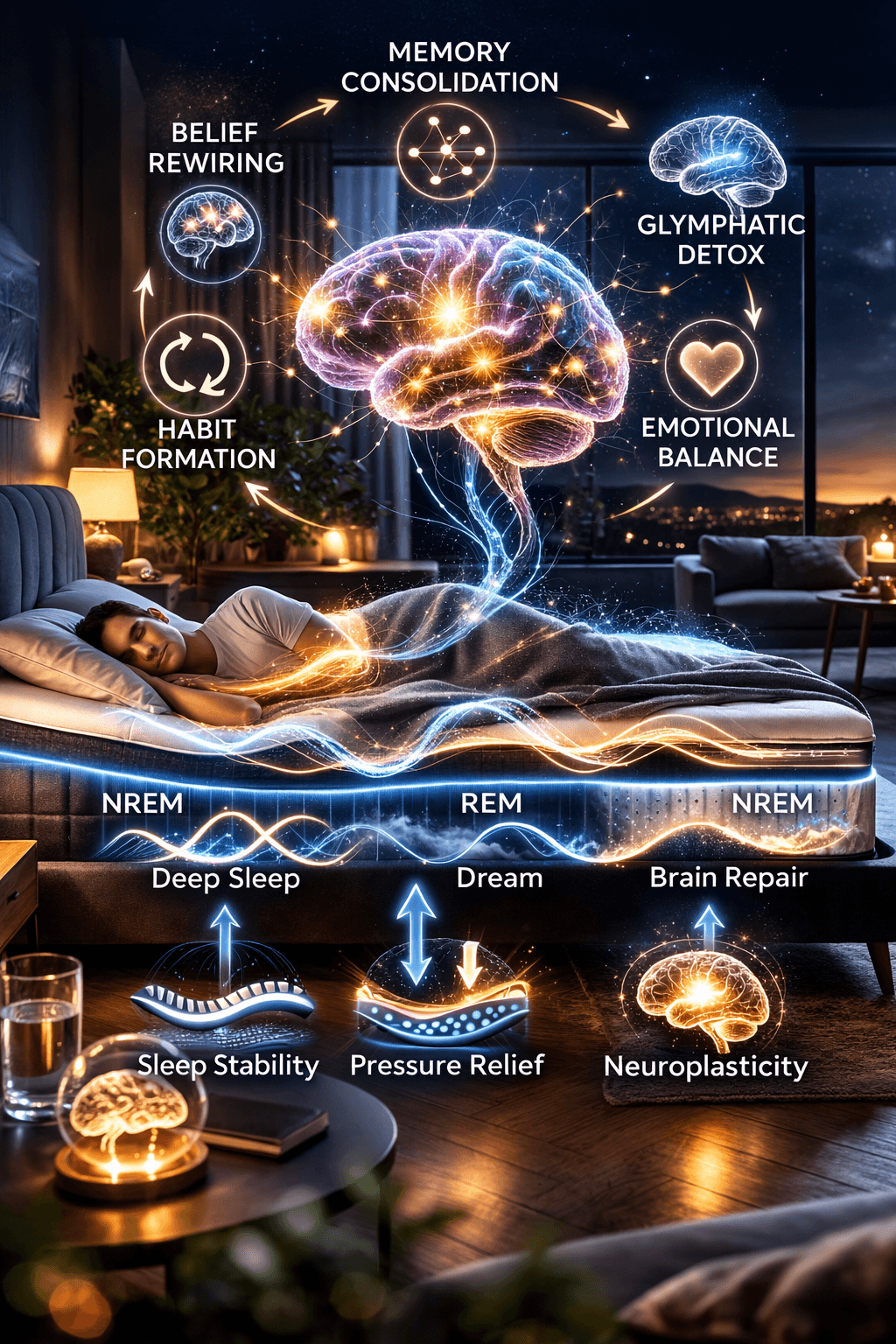
Modern neuroscience has revealed that sleep is the primary arena where neuroplasticity, the brain’s ability to change its structure and function, unfolds most powerfully. During complete sleep cycles, the brain consolidates memory, revises emotional meaning, reshapes belief systems, integrates new habits, and detoxifies itself through the glymphatic system.
If waking life is where we experience, sleep is where we become.
This article explores how neuroplasticity during sleep rebuilds awareness, identity, and behavior — and why the physical stability of the sleep environment plays a decisive role in protecting this delicate architecture.
1. Memory Consolidation: From Experience to Identity
Throughout the day, the brain records fragments: conversations, emotions, sensory inputs, decisions. These are initially stored in temporary networks, primarily within the hippocampus. Without sleep, these fragments remain unstable and vulnerable to decay.
During deep non-rapid eye movement (NREM) sleep — particularly slow-wave sleep — the brain replays these memories in a coordinated dialogue between the hippocampus and the neocortex. This replay process stabilizes and integrates memories into long-term storage [1][2].
Matthew Walker, in Why We Sleep, explains that sleep is the “night shift” for memory processing, transforming fragile short-term impressions into lasting knowledge [3]. Similarly, Stickgold and Walker’s research demonstrates that sleep not only strengthens memory but reorganizes it — extracting patterns and meaning [4].
Imagine a person learning a new professional skill. During the day, the steps feel mechanical and effortful. After a full night of sleep, something shifts. The knowledge feels smoother. Automatic. Integrated. The brain has reorganized neural pathways overnight.
Sleep does not simply preserve memory. It refines it.
Research by Diekelmann and Born shows that sleep preferentially consolidates emotionally relevant memories, shaping future decision-making and identity construction [5]. What we repeatedly experience and emotionally encode during the day becomes biologically reinforced at night.
Thus, sleep is not just memory storage. It is memory consolidation, identity formation, emotional encoding.
2. Rewriting Beliefs: Neuroplasticity and Epigenetic Modulation
Beliefs are not abstract ideas floating in consciousness. They are encoded neural networks — repeated firing patterns strengthened over time. Neuroplasticity allows these patterns to change.
During sleep, synaptic remodeling occurs through a process often described as synaptic homeostasis [6]. According to Tononi and Cirelli’s Synaptic Homeostasis Hypothesis, wakefulness increases synaptic strength globally, while sleep selectively downscales weaker or less relevant connections, preserving efficiency and flexibility [7].
This pruning is essential. Without it, the brain would become metabolically overloaded.
At the same time, emerging research suggests sleep influences gene expression. Epigenetic mechanisms — such as DNA methylation and histone modification — are sensitive to sleep patterns [8]. Sleep deprivation alters the expression of genes involved in neural plasticity, stress regulation, and immune function.
Books such as The Epigenetics Revolution by Nessa Carey and research by Walker highlight that sleep quality directly influences gene pathways linked to cognitive resilience [9].
Consider a generalized example: an individual repeatedly telling themselves, “I am not capable.” This belief has been reinforced over years. However, during a period of improved sleep, stress hormones stabilize, emotional regulation improves, and neuroplastic processes allow alternative experiences to integrate more effectively.
Over weeks, the brain begins encoding new narratives — not because of motivational affirmations alone, but because sleep has restored the biological conditions necessary for belief restructuring.
Without sleep, cognitive flexibility narrows. With sleep, neural pathways remain adaptable.
This process reflects neuroplasticity, synaptic remodeling, epigenetic modulation.
3. Why New Habits Cannot Form Without Complete Sleep Cycles
Habit formation involves coordinated activity between the prefrontal cortex (executive control), basal ganglia (habit loops), and limbic system (emotion and motivation). This integration requires intact REM and NREM cycling.
Research demonstrates that REM sleep enhances procedural memory and emotional integration [10]. Meanwhile, slow-wave sleep supports declarative memory and cognitive restructuring [1].
A full sleep cycle lasts approximately 90 minutes and alternates between NREM and REM stages. Fragmentation — whether due to stress, discomfort, pain, or unstable sleep surfaces — interrupts this architecture.
Van der Werf and colleagues found that sleep fragmentation impairs the consolidation of newly learned skills [11]. Without complete cycles, the neural pathways required for automation remain incomplete.
Imagine someone attempting to adopt a new health routine:
- Regular exercise
- Structured eating
- Reduced screen time
During the day, they practice the behavior. But if sleep is disrupted repeatedly, emotional regulation weakens, impulse control decreases, and reward pathways become dysregulated.
Walker notes that sleep deprivation amplifies amygdala reactivity by up to 60%, impairing rational decision-making [3]. Under these conditions, new habits cannot stabilize.
Neuroplastic change requires biological stability.
Sleep cycles are the scaffold on which habits solidify.
This section highlights habit formation, sleep cycles, neural integration.
4. The Glymphatic System: Nightly Brain Detoxification
One of the most significant discoveries in modern neuroscience is the glymphatic system — a cerebrospinal fluid network that clears metabolic waste from the brain during sleep.
Research by Xie et al. demonstrated that during deep sleep, interstitial space expands by approximately 60%, allowing cerebrospinal fluid to wash through brain tissue and remove toxic proteins such as beta-amyloid [12].
This process is dramatically reduced during wakefulness.
Maiken Nedergaard, one of the leading researchers in this field, describes sleep as a “cleaning cycle” for the brain [12]. Without adequate deep sleep, metabolic byproducts accumulate, contributing to cognitive decline and neurodegenerative risk.
Chronic sleep deprivation has been associated with increased amyloid accumulation, impaired executive function, and reduced emotional resilience [13].
Imagine the brain as a city. During the day, activity generates waste. At night, if the sanitation system fails, debris accumulates. Over time, the system becomes inefficient.
Sleep restores neurological clarity.
Deep, uninterrupted NREM sleep is particularly critical for glymphatic efficiency.
This process centers on glymphatic system, detoxification, deep sleep.
5. The Architecture of Sleep: Why Physical Stability Matters
Neuroplasticity depends on intact sleep architecture. This architecture requires:
- Adequate slow-wave sleep
- Uninterrupted REM cycles
- Minimal micro-arousals
- Stable thermoregulation
- Proper spinal alignment to reduce nociceptive signaling
Micro-awakenings caused by discomfort, poor pressure distribution, or overheating disrupt slow-wave continuity. Even if the person does not consciously remember waking, the brain transitions out of restorative stages.
According to research from Northumbria University, improved sleep efficiency directly enhances restorative cycling. Participants using advanced medical-grade foam technology demonstrated measurable improvements in sleep efficiency and time to fall asleep, alongside significant pressure redistribution benefits
EN NadaUp - Every night Matters…
.
Pressure relief reduces nocturnal movement caused by discomfort. Reduced movement decreases arousals. Fewer arousals preserve REM/NREM cycling.
NadaUp mattresses, developed with Mammoth Medical Grade™ foam, provide 60% improved pressure relief and 69% faster surface cooling compared to standard memory foam
EN NadaUp - Every night Matters…
. Enhanced cooling supports thermoregulation, which is essential for slow-wave initiation.
Clinical testing reported:
- 29% faster time to fall asleep
- 7% improved sleep efficiency
- 21% more pleasant sleep experience
EN NadaUp - Every night Matters…
Sleep efficiency may appear numerically small, but over a year, even a 7% increase translates into dozens of additional complete sleep cycles.
From a neuroplastic perspective, each preserved cycle represents another opportunity for synaptic remodeling, belief integration, and glymphatic detoxification.
A stable mattress is not simply about comfort. It protects sleep architecture.
And sleep architecture protects neuroplastic reconstruction.
This section emphasizes sleep architecture, physical stability, sleep efficiency.
6. Awareness, Identity, and the Rebuilding Brain
Conscious awareness feels continuous. In reality, it is reconstructed daily.
During REM sleep, emotional experiences are replayed without high levels of stress neurochemicals like norepinephrine [14]. This allows emotional memories to be reprocessed in a safer neurochemical environment.
This mechanism explains why difficult experiences often feel less intense after restorative sleep.
Stickgold describes this as “sleep to forget and sleep to remember” — we retain the informational core of a memory while reducing its emotional charge [4].
Identity emerges from this repeated overnight editing process.
Imagine someone experiencing a challenging interaction. In the evening, the emotional charge is high. After deep sleep, perspective shifts. The memory remains, but reactivity decreases. The brain has recalibrated.
Over months and years, these nightly recalibrations shape personality, resilience, and cognitive flexibility.
Sleep is not separate from who we are.
It is the biological author of who we become.
This reflects awareness reconstruction, emotional processing, identity formation.
Conclusion: Every Night Is Neural Construction
Neuroplasticity does not pause when we close our eyes. It intensifies.
During sleep:
- Memories are consolidated
- Beliefs are restructured
- Habits are stabilized
- Genes regulating resilience are modulated
- Toxins are cleared
- Emotional reactivity is recalibrated
- Identity is rewritten
But this reconstruction depends on intact sleep cycles.
Disrupted architecture limits plastic change. Fragmented sleep weakens emotional regulation. Insufficient deep sleep impairs detoxification. Without REM integration, habits cannot fully consolidate.
A stable, pressure-relieving, thermoregulated sleep surface supports continuous NREM and REM cycling — protecting the biological framework in which awareness is rebuilt.
Neuroplasticity is not a motivational concept. It is a physiological process.
And it unfolds, quietly, every night.
References
Rasch, B., & Born, J. (2013). About sleep’s role in memory. Physiological Reviews, 93(2), 681–766.
Klinzing, J. G., Niethard, N., & Born, J. (2019). Mechanisms of systems memory consolidation during sleep. Nature Neuroscience, 22, 1598–1610.
Walker, M. (2017). Why We Sleep: Unlocking the Power of Sleep and Dreams. Scribner.
Stickgold, R., & Walker, M. (2005). Memory consolidation and reconsolidation during sleep. Trends in Cognitive Sciences, 9(10), 476–482.
Diekelmann, S., & Born, J. (2010). The memory function of sleep. Nature Reviews Neuroscience, 11, 114–126.
Tononi, G., & Cirelli, C. (2006). Sleep function and synaptic homeostasis. Sleep Medicine Reviews, 10(1), 49–62.
Tononi, G., & Cirelli, C. (2014). Sleep and the price of plasticity. Neuron, 81(1), 12–34.
Massart, R., et al. (2014). The genome-wide landscape of DNA methylation and hydroxymethylation in response to sleep deprivation impacts synaptic plasticity genes. Translational Psychiatry, 4, e347.
Carey, N. (2012). The Epigenetics Revolution. Columbia University Press.
Walker, M. P., & Stickgold, R. (2004). Sleep-dependent learning and memory consolidation. Neuron, 44(1), 121–133.
Van der Werf, Y. D., et al. (2009). Sleep benefits subsequent hippocampal functioning. Nature Neuroscience, 12, 122–123.
Xie, L., et al. (2013). Sleep drives metabolite clearance from the adult brain. Science, 342(6156), 373–377.
Ju, Y. E. S., et al. (2014). Sleep quality and preclinical Alzheimer disease. JAMA Neurology, 71(5), 587–593.
Walker, M. P., & van der Helm, E. (2009). Overnight therapy? The role of sleep in emotional brain processing. Psychological Bulletin, 135(5), 731–748.